
I liked not Hamnet
Hamlet deserves better than Maggie O’Farrell and Chloe Zhao’s screenplay

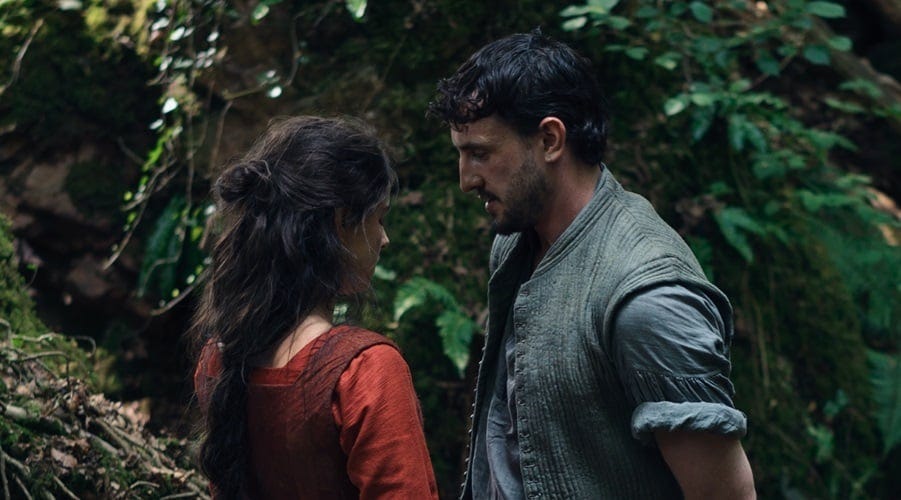
Hello! Welcome (or welcome back) to Leave It (Un)Read, the newsletter that knows foul deeds will rise/ though all the world o’erwhelm them, to men’s eyes.
Today, I am here to talk about Chloé Zhao’s Hamnet, based on the Women’s Fiction award-winning novel of the same name by Maggie O’Farrell.
This was not the plan. The plan was to launch a two-parter on the economics and homoeroticism of Ayn Rand’s sesquipedalian Atlas Shrugged, a two-parter whose belly-flop would be heard around the world. The slap of its tum-tum hitting the water would have made you deaf in both ears, your nose and pinkie toe. Oh, it would’ve been glorious.
And one day perhaps, if you’re very good, you might get to see it still. But as it happens, I watched Chloé Zhao’s Hamnet, and was so irritated that when I got home I pounded out a typo-ridden thread on Twitter without waiting to take my coat off. I had to read three chapters of The House of Mirth to calm myself down. So here we are.
I’ll briefly summarise the plot, the critical reception, what I liked and didn’t like about the film. In homage to the film, I will also be liberally misapplying actual lines from Hamlet.
Belike this show imports the argument of the play.
Enter a woman, Agnes (Jessie Buckley), and a young glover’s son Will Shakespeare (Paul Mescal). He loveth her, and of their love her womb quickens. They wed. Of their union there cometh first a daughter and then twins, a girl Judith and a boy Hamnet. The pestilence claimeth Hamnet while Will is from home, and Agnes sorrows and sorrows and casteth poignards of her rage at Will for leaving her so bereft. Until she learneth of the moste lamentable tragedie Hamlet, and sees what matter Will has made of the grief it seems he doth protest not.
‘Neighbour Leave It (Un)Read,’ you say, ‘dost thou intend to labour ‘pon this theme the while?’
‘I cry you mercy, Neighbour Reader,’ I respond. ‘This nuisance ceaseth now.’
For if the King like not the comedy/ Why, then, belike he likes it not, perdy.
Hamnet has divided critics immediately. While praise for Jessie Buckley’s performance is unanimous, people gnaw their lips a bit more about other aspects of the film. For example, the BBC is scornful about the film’s nudge-nudge-wink-wink references to Hamlet and other plays, and Salon.com pours odium on the film’s manipulativeness: “If you’ve ever experienced loss or read “Hamlet” — so if you’re most people on Earth — you’re an easy mark for Zhao’s weepy, cinematic schmaltz.” The Independent had a truly atrocious, nakedly misogynistic (at least) and racist (almost certainly) attack on Zhao rooted in her time spent writing fanfiction, for some reason.
None of this has prevented Hamnet from scooping up eight Academy Award nominations, including for Best Picture, Best Director, Best Adapted Screenplay, and Best Actress in a Leading Role.
For goodness, growing to a pleurisy/ Dies in his own too-much.
So let me first say what I liked about the film.
Taint not thy mind, nor let thy soul contrive/ Against thy mother aught.
Jessie Buckley plays a very Jessie Buckley Type in Hamnet – earthy, fierce, intelligent, free-spirited – and long experience with the Jessie Buckley Type has made Jessie Buckley a pastmaster. In all seriousness, this role is transparently an actor showcase, and Jessie Buckley tears into it with fire and thoughtfulness.
Lights, lights, lights!
Łukasz Żal’s camera is lush, dreamy, by turns portentous and swoony. It makes pockets of mystery and omen in every gnarled oak or dim corner. A genuine treat.
The play’s the thing
In the film’s climax, Agnes attends a production of Hamlet. She sees her husband play the Ghost, and watches the actor playing Hamlet, who looks a great deal like her dead son. When he delivers ‘To be or not to be,’ she reaches out to him, as do the rest of the groundlings. I understand there are eyerolls about the schmaltziness of this, but I thought it was a moving and effective tribute to the power of art to transport, to show you that you are not alone.
Forty thousand brothers/Could not with all their quantity of love/Make up my sum.
The film consciously mirrors the close relationship between Agnes and her brother Bartholomew (Joe Alwyn) with that between Hamnet and Judith. I liked the low-level, quasi-incestuous hum of their codependence.
His semblable is his mirror
The film nods dutifully to the Shakespearean canon at various points, with varying degrees of deftness. There’s Romeo and Juliet in Will and Agnes’s first meeting, and their instant attraction to each other (and if you somehow didn’t grasp that, don’t fret; we cut immediately to Will scribbling Romeo’s part from the Balcony Scene). There’s Othello and Desdemona in Agnes’s Manic Pixie Dream Girlish invitation to sensitive young Will to tell her, Agnes, a story that means something to him, Will. Hamnet and his twin Judith dress as each other in a clear nod to Viola and Sebastian in Twelfth Night.
I … well, I can’t say I enjoyed them, precisely, but I understand they had to be done, and some of them were done all right?
And… that’s it, I’m afraid.
Each toy seems prologue to some great amiss.
Before we begin, let me confess that while I’ve read excerpts, I have not read the book, so have no idea how many of my problems with the film are actually problems with the source material. Given that O’Farrell co-wrote the screenplay, I assume a fair few of the film’s … shall we say qualities? … are inherited from the book, but I can’t say for sure. let me know if I should read the book.
My second caveat is purely idiosyncratic, and I’m putting it here so you know not to read further if you disagree with me.
You would pluck out the heart of my mystery
Other people have pointed out that it’s a bit trite to reduce the creative process of a famously inward and complex play to: Sad Dad Rited Sad Play Hamlet. In fairness to O’Farrell and Zhao, they’re hardly the first to do it: there’s a thriving academic cottage industry in the pipeline from Bard Life to Bard Lines. For example, Stephen Greenblatt argues that while the similarity of the names Hamnet and Hamlet may have been a coincidence, it’s still clear that Hamnet’s death inspired the step-shift we see in Hamlet in terms of creative experimentation and technical mastery compared to his previous work. But for all its scholarship, the essay’s argument boils down to:
Hamlet feels really personal to me, so it must have been really personal to Shakespeare.
Shakespeare’s son Hamnet died shortly before the play was produced, and the death of a child is an insanely traumatic event.
Eh? Eh?
Eh?
And of course the death of a child is a traumatic event, and very plausibly there were echoes of that grief in everything Shakespeare wrote afterwards. And you are not alone, Professor Greenblatt, in feeling an almost mystically personal connection to Hamlet (play and character). But do you think that maybe, just maybe, that is also because Hamlet is a very, very good play written by an artist approaching the top of his game?
‘But Shakespeare’s linguistic and creative output increased exponentially after the death of his son!’ Yes, Professor, he was an artist who had been working for some time, and creative development is often nonlinear.
I can imagine Shakespeare’s indignation at having his technical mastery dismissed as autofiction, but thankfully I do not need to imagine. Hamlet himself snarls at his perfidious friend Guildenstern1for thinking he can be more easily known and manipulated than a pipe:
HAMLET: Why, look you now, how unworthy a thing you make of me! You would play upon me; you would seem to know my stops; you would pluck out the heart of my mystery; you would sound me from my lowest note to the top of my compass; and there is much music, excellent voice, in this little organ, yet cannot you make it speak. ’Sblood, do you think I am easier to be played on than a pipe? Call me what instrument you will, though you can fret me, you cannot play upon me.
But I suppose it’s progress in a way. Jane Austen, Charlotte Bronte, George Eliot, they’ve all been subjected to the hot breath of grasping little toadstools eager to dismiss their genius as autofiction. Let a dead white man get the treatment. And not just a dead white man, arguably the Dead White Man. Diversity Win!
I will admit, however, the real reason that I’m not the target audience for biographies of famous artists or How This Great Work Was Made: I don’t care. Everything I have ever learned about Shakespeare’s life has been against my will (pun intended).
And this is because a biography might give me clues as to what prompted a work, or even what generated it, but that is almost never what actually interests me. The idea for a book might make me pick it up, but its execution is what stays with me. As Hamlet itself points out, everyone on the planet has lost or will lose a father (and that father lost, lost his); but not everyone writes a Hamlet. Belleforest’s chronicle of Amneth was available to many, but they did not explode its central plot mechanism and do with it what Shakespeare did.
The fact that Shakespeare lost a son to the plague is interesting in that human loss and grief are interesting. But pretending that it has literary interest is, to me, like pretending that leaking the transcripts of Charles and Camilla’s dirty talk was in the public interest.
Virtue itself ’scapes not calumnious strokes.
Anyway, if you’re still here, here are some of the things I’d have found dodgy even if this were my sort of thing.
The time is out of joint
Or, why make a period drama if you’re not interested in making a period drama?
Look, I know I go on about this a bit, and I swear I’m not a pedant. I like a cheeky anachronism, me. A Knight’s Tale is a long-standing favourite. I took Hamnet’s repeated uses of ‘It’s OK’s on the chin! I’m a trouper, I promise. I don’t demand Robert Eggers’s fidelity, or even the Robert Bolt/Hilary Mantel solution of broadly modern dialogue, no obvious anachronisms and the occasional judicious period slang. I don’t care, so long as these Old-Timey people look and act the way people with Old-Timey beliefs and incentives would.
So why, for example, does Agnes behave as though she is entitled to a husband who speaks his feelings as though he’s on a late-twentieth-century therapist’s couch? Why does she piss and moan at him for going back to work after the death of their son? Bitch, he has three mouths to feed. I buy that a Tudor woman may feel abandoned by her husband and family after the death of her husband, but I do not for a moment believe she would articulate it as such to herself, let alone to him.
There is a type of historical novelist/filmmaker/whatever who affects to believe that what people want from historical fiction is to see themselves – their attitudes, their actions, their reflections – reflected back to them in bonnets or wimples or gowns. And maybe this works for some people – I doubt it, but maybe. But me personally? When I look in a mirror, I don’t run to the teacher because the girl in the glass is copying me.
‘Tis now the very witching time of night
Agnes is ‘the daughter of a forest witch’, which manifests in communion with hawks, herbal lore and the insistence on midwifing herself. She manages this for her first-born, dragging herself out to her very own hole in the woods in a way that should have Junji Ito consulting a copyright attorney.
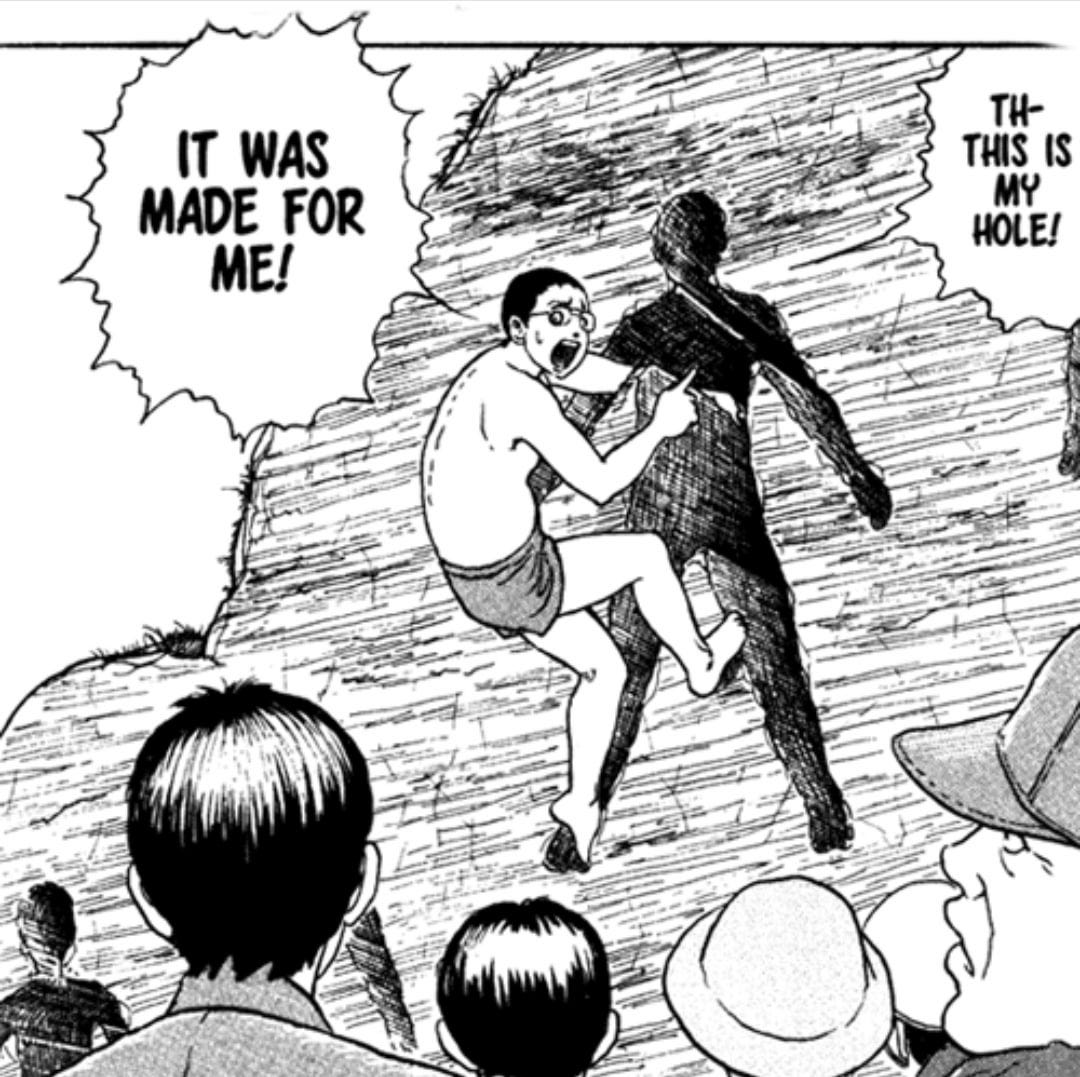
She is not allowed to do this for Hamnet and Judith, which is a bad omen. And don’t make me tap the Ursula le Guin2 Sign, lads.
But I didn’t and still don’t like making a cult of women’s knowledge, preening ourselves on knowing things men don’t know, women’s deep irrational wisdom, women’s instinctive knowledge of Nature, and so on. All that all too often merely reinforces the masculinist idea of women as primitive and inferior – women’s knowledge as elementary, primitive, always down below at the dark roots, while men get to cultivate and own the flowers and crops that come up into the light. But why should women keep talking baby talk while men get to grow up? Why should women feel blindly while men get to think?
There’s something even more eye-twitching about Hamnet’s choice, because it’s not women’s knowledge, or women’s stories, that the film is putting front and centre. It’s woman, singular. And what a very singular woman. She knows a hawk from a handsaw! She knows her herbs (this being unusual for a semi-rural Tudor Midlandswoman, for some reason?)! She midwifes herself all by her lonesome!
It’s infuriating, because women have in fact been bonding together through birth, death and marriage throughout the centuries. A story centring the women of Shakespeare might perhaps have examined female community, and the grim realities of the hussif. But then how could we show how Not Like Other Girls Agnes is?
But this eternal blazon must not be/ To ears of flesh and blood.
Storytelling, she said, stroking her chin, is like jazz: it’s all about the notes you don’t play. And look. I get how irritating it can be for people to make up the story they wanted to see, and get mad at a work for not giving them that. And I promise I’m not here to do that.
For example, other people have pointed out that Anne Hathaway seems to have been an interesting lady in her own right: literate, keeping the house together and supporting her artist boytoy. That might have been a fun story, but it’s not the one O’Farrell and Zhao wanted to tell, and I respect that, I promise.
Similarly, it’s quite cool for the film to gesture at stories behind the doors of the story it is telling, so to speak:
In the film, Shakespeare’s abusive father dies shortly before the production of Hamlet3 – famously a play about dead and demanding fathers. If we are reducing creation to life trauma, this might have been an easier in.
Hamnet and Judith dress in each other’s clothes, much as Viola and Sebastian do in Twelfth Night, written five years after Hamnet’s death. In the play, Viola goes to great lengths to dress as the twin brother she believes to be dead, consciously trying to bring him back from the dead in her own person. The film never bothers with Judith’s feelings, but this too seems an easier throughline than the one the film chooses.
And whatever, it’s fine. You don’t have to tell those stories. Just, you need to make a case for the story you are telling. And the film never seems to think it needs to, beyond:
Hamnet and Hamlet were used interchangeably in Tudor England
Shakespeare’s son Hamnet died before he wrote the play Hamlet
Hamnet had a mother too
Eh? Eh?
Eh?
And I dunno, I don’t think that’s enough.
And so good night, ladies, good night, sweet ladies, good night, good night.
Or is it Rosencrantz?
Le Guin, Ursula K., (2019). What Women Know, in Words Are My Matter: Writings on Life and Books, Harper Collins.
In reality, Shakespeare’s father would die after the play was produced, though the writing may well have been on the wall.
Yay! You did Hamnet. Totally agree with your thoughts. I have read the book, though, and imo the movie sanded down a lot of the things I hated about the novel. If you think Agens is "not like other girls" in the film, my god, she's ten times worse in the book. Super-special-magical-pixie-nature-creature. The book also demonises all the older women in comparison to her, which I found really weird given Maggie O'Farrell is an older woman. Online Hamnet movie fans are feral, though. They come for you with knives if you express anything but adulation.
This is an interesting perspective! I really liked Hamnet (though honestly, I was an "easy mark", what with grieving loss and loving the play) on my first watch. However, I recently rewatched it and I agree, there is a certain "not like other girls" energy to Agnes. The relationship between Shakespeare and Hathaway has been also been interpreted by academics very differently (left her a "second-best bed", like, what's up with that??). That layer could've been really interesting too. Their whole dynamic felt a little...flat.
Even on a rewatch, though, I was struck with how lush and gorgeous the movie looked.