
All Buzz And No Bite
Madeline Cash’s Lost Lambs, reviewed

There’s something uniquely satisfying about a conspiracy, isn’t there? Nothing so unites the exquisite pleasures of simplicity and self-aggrandizement. There really is a single cause for disparate evils, and you really are among the few, the happy few, who see it. You may be ridiculed, even persecuted, for speaking the truth, but history will vindicate you in the end.
Anyway, today I want to talk about Lost Lambs.
Lost Lambs
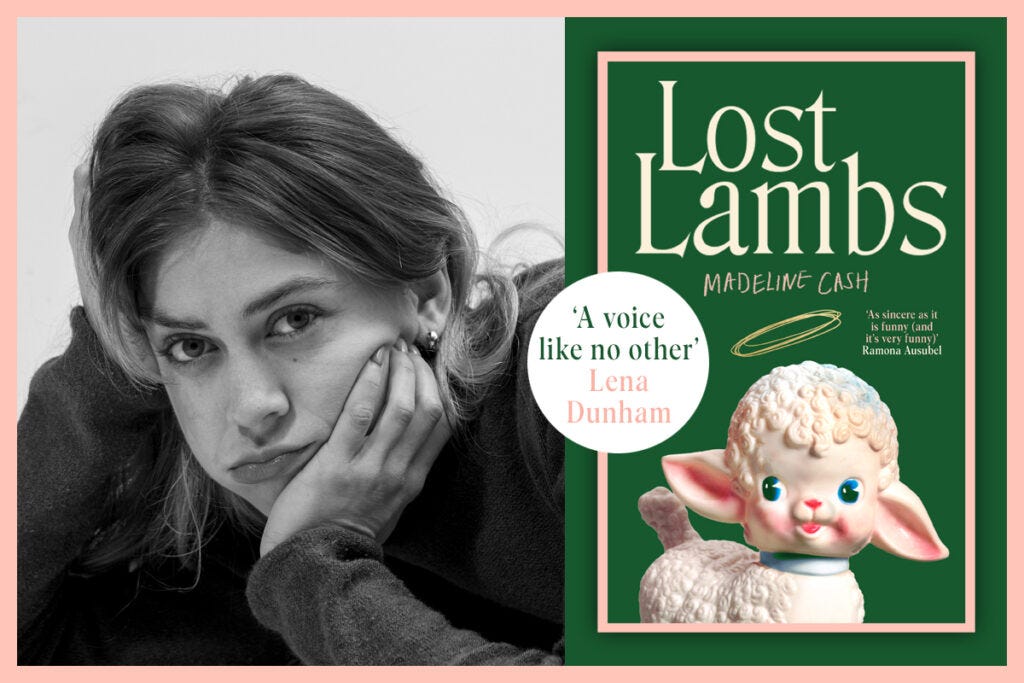
Lost Lambs is the debut novel by Madeline Cash, released early in 2026. Immediately upon its release, the Anglophone publicity apparatus made Cash ubiquitous with Olympian speed and vigour. She turned up in the New York Times, the Atlantic, LitHub, Vulture, the Washington Post, Vogue, the New Yorker, and others that I am forgetting. This shock-and-awe-ing led Freddie de Boer on Substack to smell something very rotten in the state of Denmark.
…the massive rollout for Madeline Cash’s Lost Lambs is a very good example of a coordinated media campaign that has been, to some degree and in some way, orchestrated from above. I don’t know the exact mechanism, but I can tell you for a fact that this level of immediate, simultaneous media penetration does not happen with literary fiction without people in positions of power making it happen.
Substack being a platform combining in many ways the truest essence of Twitter and a substitute teachers’ break-room, the Cash Conspiracy took flight. Becca Rothfeld and Garth Greenwell pooh-poohed, and Leigh Stein reminisced about being the It Girl.
In the end, I don’t disagree that there’s a conspiracy, though how much of a conspiracy can it be if nobody bothers to hide it. It’s not surprising that Madeline Cash, well-known in the New York alt-lit scene, has been taken to the bosom of Anglophone publishing. Anglophone publishing has a somewhat limited bag of sales tricks. It knows how to sell a young, hot, well-connected white woman. It goes out into the rippling meadows of the New York and LA alt-lit scenes during prime harvesting season every year to find the next young, hot, well-connected white woman in an attempt to reverse-engineer Joan Didion. Publishing believes, with touching simplicity, that a sufficiently nubile, photogenic white female tulpa will resurrect the days when literary fiction had cultural and — more importantly — economic relevance.
As it happens, there is also a conspiracy in Lost Lambs, which is what I want to talk about. The book itself, I mean, not the book qua Discourse Object.
Lost Lambs (for real this time)
Lost Lambs is the 2026 debut novel by Madeline Cash. It is about the Flynn family, who are in various states of suburban ennui in their company town. The mother is attempting to break out of her quiet desperation with a sort-of affair with a neighbour given to yonic ceramic sculptures. The father is having an affair-affair with another neighbour, leading a support group in the most Protestant-ass Catholic church that you ever did see. The eldest daughter, still in high school, has taken up with a veteran they call “War Crimes Wes”. The youngest daughter, precociously intelligent, has been suspended. The middle daughter has been radicalised in an internet chatroom. And there’s something hinky going on with the books of the father’s billionaire employer dot dot dot.
Reception
As mentioned above, Lost Lambs was positively bukkake’d with attention on its release. “a combination of tenderness and satire”, said the Guardian. “Wonderfully wacko,” said Vulture. “Buzzy, hilarious, and richly rendered,” said Vogue, “the first Internet novel with the potential for broad offline appeal,” said the Atlantic.
To be fair, this praise was not unqualified in any of these cases. Some variant of “uneven” tended to be used, while still assuring the reader of Cash’s undeniable promise.
And as for me: Lost Lambs is… fine. It’s fine. Its first half is cute enough, in a laboured McSweeney’s sort of way, and in the second half it gets lost (sorry). It’s perfectly pleasant, and you will lead a rich and full life without ever opening it.
I’m not going to do my usual palaver about what I liked, followed by what I didn’t like, because I honestly didn’t feel strongly enough about either to commit. Instead, I’d like to talk about a few elements of the novel that stood out to me, for good or ill. Spoilers from here on out, but you can stick around even if you haven’t read it. Knowing the plot won’t harm your reading experience of Lost Lambs; it’s not really that kind of book.
Siggnature element
Early in the novel, the most Protestant-ass Catholic church that you ever did see has a gnat infestation. From then on, every time a word with the letters “nat” shows up, the letters are replaced with “gnat”. I was tempted to do the same thing in homage in this very post i.e. replace “coordinated” with “coordignated”, “combination” with “combignation” and so forth, before wiser counsels prevailed. I enjoyed this little verbal flourish a lot. So much contemporary fiction is so dour, I liked the whimsy.
The only issue is, it doesn’t really do very much. I thought, at first, that the gnat infestation mirrored the spiritual rot of suburbia that is the burden of this novel, that maybe it would escalate as the family got worse and potentially peter out once the family hugged and learned or whatever, but that didn’t happen. There didn’t seem to be any correlation, let alone causation, between the two. The linguistic domignation of the insects seemed designed only to be mildly irritating. Like. You know. The gnats. It felt like a missed opportunity.
Of what is this a satire?
Most reviews settled on calling Lost Lambs a “satire”, which raises the question: of what? The Flynns are, it is true, largely composed of stock characters: disappointed artist parents, anorexic popular girl, precocious brainiac, attention-starved middle child. But there is none of the intentional high definition or caricature that you would expect of satire. Even the parents’ “nonconsensual nonmonogamy” is playing off neither picket-fence conservatism or self-conscious hippiedom (the neighbour’s misshapen ceramic vaginas notwithstanding).
Similarly, there are strands of mockery of attractive women’s shallow self-absorption, and specifically obsession with thinness. Thus Harper, the youngest daughter, who on her return from a wilderness camp for troubled teens where she has been starved and sleep-deprived, finds her cheekbones are more prominent and that the face looking back from the mirror is pretty. Thus also Abigail, the popular, beautiful eldest Flynn daughter:
“Eat something,” said Tibet. “You look emaciated.”
“Thank you,” said Abigail.
“No, like, you look like a war prisoner,” said Tibet.
Wasn’t she? Her heart was anyway. Abigail looked down and admired her own small limbs. Having less of her to hold forced people to find more of her to love. She found this thought poetic.
I don’t care if this is problematic, but what is being achieved here? Are we really, in 2026, especially shocked to learn that young women are valued for their thinness and beauty?
The dénouement of the novel features the father’s billionaire boss inviting beautiful Abigail to an Eyes Wide Shut party, where the book’s underpinning conspiracy is revealed: the boss is engaging in light human trafficking, kidnapping beautiful young women for the purposes of drinking their blood. This, you may think, is a satire of our present ruling class. But is it satire if Peter Thiel really does allegedly engage in parabiosis for longevity, or Bryan Johnson really is obsessed with biohacking to live forever? I accept that in our present benighted moment, our bill(and now trill)ionaire overlords’ only real innovation is in auto-parody, but you’re the one who’s supposed to be writing a satire here. Which brings me to a related point:
Maybe wait for the teeth to come in
Lost Lambs is called variations of tender, wry, loving, yadda blee yadda blah. The burgeoning domestic terrorist in the family wanted to be a beauty queen, and wanted the love of the dreamy (presumably) Islamic fundamentalist on the other side of a chat. She is intercepted well before she does even the whisper of harm. The wilderness camp to which the precocious Harper is shipped lets her go after only light starvation and sleep-deprivation. The pseudo-Epstein billionaires’ cult is explicitly horrified at the suggestion that they would sexually exploit the beautiful girls they traffic. The paterfamilias is lightly suicidal, but extramarital Christian love saves him.
It is completely fine to make humour out of serious topics — in fact, that’s what I was hoping for — but the book’s attitude to said topics doesn’t seem to be mockery, so much as nervousness. Lost Lambs gums at the outlines of an array of (ugh) “edgy” topics before moving on with a twirl of its Lolicon pigtails. Not a single ray of darkness is allowed to linger overlong in this novel’s pastel moodscape. The book even ends with the family united around a table after rescuing Abigail and the parabiosis victims, scarfing carbs and nattering (gnattering?) happily. I’m pretty sure this book’s fans will say ‘bUt tHAt’s SAtiRe,’ and I invite them to spend some time with a dictionary.
Party like it’s 1999
I was convinced, for the longest time, that Lost Lambs was a period piece and nobody had bothered to mention it. This isn’t just because its closest literary referents are extremely early-2000s (The Corrections, White Teeth), but because of the extremely weird absence of technology that would be unshakeably ubiquitous for at least the young Flynns. I was so thrown in the final chapters when characters watched a video on their phones. ‘If you can do that,’ I remember thinking, ‘why aren’t you on TikTok, or GnitGnat, or whatever it would be called in this universe?’ It doesn’t end there. The middle daughter gets radicalised in an internet chatroom, for some reason. Even the Islamophobia and the obsession with thinness feel retro1 — more 9/11-adjacent than anything contemporary.
The humour, too, feels generally Millennial. Here, I’m being mean, but take a look:
Years ago, Bud’s parents had moved a few states inland to a minor city that touted record-breaking heat near a college that reported record-breaking date rape.
I know Madeline Cash is twenty-nine years old, but if I didn’t know better I’d swear Lost Lambs was written by a quant analyst during Financial Crisis layoffs, abandoned when Goldman was hiring again, and forgotten for nearly twenty years. In fact, here’s a real conspiracy theory for you. Madeline Cash didn’t write Lost Lambs at all! She pinched the manuscript from a geriatric millennial relative who died in a freak avocado toast incident, and is passing it off as her own. Not Yellowface, so much as On-Fleekface.
A Prestige Dramedy in Waiting
The New York Times subtitled its review of Lost Lambs with ‘If The Royal Tenenbaums Were Middle-Class And Likable, They’d Be This Madcap Family’. It’s not a bad comparison — Wes Anderson is clearly all over this book’s affect, as is the dysfunctional family of Arrested Development (Seasons One to Three, to be exact), or the middle-schooler wannabe-beauty-queen in Little Miss Sunshine. In general, there is a certain class of wry, winky, drawly 2000s-2010s film or TV show that Lost Lambs evokes far more readily than any book. The characters don’t have interiority, so much as a narrator who would ideally be voiced by, if not Ron Howard, then Patton Oswalt or — hear me out — Tom Hanks.
Lost Lambs is not a book, so much as a prestige dramedy in waiting. In its spiritual temporal home, it would have been an Emmy-winning show on Amazon Prime, with heavy involvement from the Duplass brothers. Now, it’ll likely be on Apple TV, with heavy involvement from A24 and — still, somehow — the Duplass brothers. I’d wait for that, if I were you — apparently Tom Hanks’s narration is a treat.
Not that fatphobia’s gone anywhere; the book just expresses it in a distinctly early ‘000s way.
Another hit. I think you broke down every major instance of friction I felt on my readthrough. I really enjoy how your reviews feel like walking out of a movie theater into the still-bright evening, arguing with an enviably smart friend, distilled into an article - it's a cool and rare feeling to apply to literature. Just very good.
If there's any unique praise I have for Lost Lambs, it's that it has generated some excellently written critical reviews.
YES the whole book felt so 2000s! Eating disorders........ ISIS paranoia............ teens dating 23-year-olds............ welcome back, 2003
Loved this article. Your writing is so funny.