
Bad(el) Education
The insufferable hectoring of RF Kuang's Babel


Hi! Welcome back to Leave it (Un) Read, the letter about the necessity of doing a bit more than saying Bad Racist People Are Bad, Also Racist.
Today, we’re talking about RF Kuang’s award-winning 2022 bestseller Babel, a book I wanted very badly to like.
I came to Babel because my absolute bulletproof comfort listening is hours-long breakdowns of insanely popular novels belched from the depths of BookTok - books I have zero intention of reading, ever, but whose evisceration I feel a sick compulsion to witness. Three of my favourite content creators all adore Babel.
That said, every single one of my friends who has read it cannot abide the book.
If you have understood the guiding concept of this newsletter, I assume you know where I fall.
Okay, okay, due diligence time. I’ll give you a brief, un-spoiler-y synopsis of Babel, so if it takes your fancy you can read it with unbesmirched eyes.
Babel Studies B101: Babel Basics
First off, I should say that the full title of Babel is Babel : Or the Necessity of Violence : An Arcane History of the Oxford Translators’ Revolution. A fun title - note the superfluity of colons! A title that creates certain…expectations… of the style of narration, at least in this reader. Expectations that will not be met. I will return to this later. For now, I bring it up to note that Babel : Or the Necessity of Violence: An Arcane History of the Oxford Translators’ Revolution is something of a mouthful, so I will follow convention and just refer to the novel as Babel for this letter and the next.
Babel is a work of speculative fiction by RF Kuang, published in 2022. It is set in an alternate 1830s, where the wealth and influence of the British Empire is powered by magical silver bars. The power of these bars is driven by language - specifically, the gaps in translation between languages. The protagonist is a biracial Chinese man who loses his family to cholera. He is brought to Britain at the age of ten by a cold, remote but clearly wealthy British man, and given a scholarship to the prestigious and wealthy Babel, the Oxford college which is the seat of translators worldwide, and therefore the engine of Empire. He is bewitched by the dreaming spires and the pleasures of academia, but it becomes harder and harder to ignore the ways in which he is complicit with the evils of Empire.
Sounds promising, right? I was excited when I first heard about it. Especially when I heard about RF Kuang’s impressive and highly-relevant-sounding academic pedigree: she majored in history at Georgetown, she has an MPhil in Chinese studies from Cambridge, an MSc in contemporary Chinese studies from Oxford, and is doing a PhD in East Asian Languages and Literature at Yale.
So if I’ve whetted your appetite, off you go. Maybe come back when you’re done and we can discuss.
If you’re in I Ain’t Reading All That mode, I got you: Babel is a work of speculative fiction with a really compelling premise and very cool magic system. If only the author could. You know. Write.
If you do have the stomach to Read All That, a reminder that from here on out, I will be fairly cavalier with spoilers. If you have stuck around, I assume you’re okay with that, yes?
Okay, great.
Let’s talk about the critical reception of Babel.
Babel Studies B101a: a Review of the Literature
Babel debuted at the top of the New York Times’ bestseller list for hardcover fiction. It had generally positive - and some glowing - reviews. Kirkus Reviews called it ‘dark academia as it should be’, preceding this assessment with ‘It’s ambitious and powerful while displaying a deep love of language and literature’. The Chicago Review of Books called it ‘brilliant both in concept and execution, is a page-turner with footnotes, a thriller with a higher purpose, a Bildungsroman where the stakes matter.’ The Guardian, particularly delighted by RF Kuang’s extremely impressive academic pedigree, enjoyed Babel’s use of footnotes and its precocious young heroes: ‘This is a scholarly book by a superb scholar – Kuang is a translator herself. The pages are heavy with footnotes; not the more usual whimsical ones, in the style of Susanna Clarke or Terry Pratchett, but academic notes, hectoring and preachy in a parody of the 19th-century tomes Swift and his friends at Oxford must study. The characters’ conversation flies from theories of translation to quotations from Sanskrit, from Dryden to the authors of the Shijing; they are pretentious, but vulnerable too, and the balance is lovely.’
I noticed the footnotes too. I will return to them later.
In the New York Times, Amal el-Mohtar, co-author of the bestselling This is How You Lose The Time War, said ‘Babel derives its power from sustaining a contradiction, from trying to hold in your head both love and hatred for the charming thing that sustains itself by devouring you.’ Having now read This is How You Lose The Time War, El-Mohtar’s endorsement is an after-the-fact red flag.
Not all the reviews were so enamoured with the book. Paste Magazine called Babel ‘an ambitious epic that doesn’t trust its audience enough’ and Publisher’s Weekly said Babel ‘underwhelms with a didactic, unsubtle take on dark academia and imperialism.’
But that didn’t prevent Babel from taking major awards by storm. It won the 2022 Nebula Award for Best Novel, and the 2023 Locus Award for Best Fantasy Novel. It netted enough nominations to be in the running for the 2023 Hugo Award, but was ruled out by the administrators without further explanation. This decision sparked immediate rumours of the Hugo Award administrators preemptively truckling to censorship in China, the host country of that year’s awards. These rumours went a long way to being confirmed when a whistleblower leaked emails filtering out novels ‘of a sensitive political nature,’ including other works by authors who have been publicly critical of the actions of the Chinese government.
This, of course, is grim and disappointing. I don’t think Babel should have been excluded from contention for the Hugo Awards because of its politics, or those of its author.
By that same token, I am given to understand that RF Kuang is something of a villain in certain online circles. Anything she posts online attracts a frothing rage I don’t understand. I have not investigated RF Kuang’s behaviour, and I’m not going to. I am going to go out on a limb and say I can’t imagine anyone or anything deserving that sort of reaction.
Well, I mean, I tell a lie. I know two things RF Kuang has done that merit a certain … shall we say disproportionate?... intensity of reaction.
Thing One, she’s a woman. First mistake.
Thing Two, she’s a person of colour. Second mistake.
That does not prevent RF Kuang from being A Problematic, of course. And maybe she is. I am not up on my RF Kuang Lore. I don’t know and for the purposes of this letter, I don’t care, all right? I don’t think Babel should have been censored. RF Kuang should not be the target of vitriol from chronically online racists who don’t know they’re racist. I’m especially annoyed by this reception because it obscures the real issue.
Don’t slag off Babel because you want to Cancel RF Kuang, all right?
Slag off Babel because it’s garbage.
Babel Studies B102: Intermediate Babel
Before I start opening up my budget on Babel, let’s provide a bit more detailed of a plot summary.
As before, Babel is set in an alternate 1830s, at the height of the British Empire as our current histories have it. However, there’s a twist: the Empire is powered by magic silver bars. Silver bars can be supercharged with what is lost in translation i.e. between words in different languages that have similar - but different - meanings. Such words are called ‘match-pairs’. Each is immensely valuable and their discovery is entered in a register - think patents, or a brilliant venture capital idea. Since these gaps in translation power the Empire, a disproportionate amount of influence and wealth rests with translators, the bulk, and certainly best-funded, of whom reside in Oxford’s Babel.
The novel’s protagonist, Robin Swift, loses his family to cholera but is ripped from the jaws of death by an Englishman wielding one of those magic silver bars. This man is Professor Richard Lovell, a cold, distant man with a considerable physical resemblance to Robin. Robin is taken from Hong Kong to Britain and it is made very clear that his only worth to his guardian - and biological father, not that he’ll acknowledge it - is his academic prowess in linguistics, grammar and translation.
Robin goes to Oxford, and is inducted into the mighty Tower of Babel, where he will learn the arcane art of magical translation. There, he meets a diverse group of scholars, on both gender and ethnic dimensions: Ramy, a charismatic Bengali Muslim man from present-day Kolkata, Victoire, a Black girl from Haiti, and Letty, a white Englishwoman. Robin loves academia. He is seduced by its freedoms and the generous stipend he receives - a well-funded humanities student being a sure sign you are reading a fantasy novel. But then he meets another biracial Chinese man called Griffin. Griffin looks so much like Robin that we immediately realise that he’s another illegitimate son of Professor Lovell, imported for his linguistic gifts. Griffin inducts Robin into a secret society of revolutionaries, and Robin goes along with it for… reasons I guess. Robin feels caught between two worlds, guilty for betraying the Empire which has given him so much and also for lying to his friends. Ultimately, worn down by the secrecy, Robin quits his revolutionary brethren.
Robin and his ethnically and gender diverse pals are taken on a trip to China, where Robin’s translation skills are pressed into service. On his return to the country of his childhood, Robin is shocked by the Empire’s culpability in precipitating an opium crisis in China. Upon being berated by Professor Lovell on their return trip, Robin impulsively kills his father, which is covered up in panic by his friends. On their return to the United Kingdom, the friends learn that Britain never had any good-faith intention of treating with China, wanting only to precipitate a nice old Opium War.
Robin discovers that both Ramy and Victoire are members of the same revolutionary secret society that he left - in other words, not one, not two, but three out of four of the super special friend group are revolutionaries - a development that gets very unintentionally funny very quickly. Letty walks in on the worst conspirators in the world, promises up and down to protect them, and then betrays them anyway. Many of the revolutionaries die, including Ramy and Griffin. Robin decides to spearhead a violent overthrow of the Empire by taking over the Tower of Babel. He neutralises the magic silver bars through a stratagem I won’t spoil, but which was foreshadowed with blinking neon lights in like Chapter Ten or Eleven. Robin dies but Victoire lives. It is implied she is set to make contact with the remaining members of the revolutionary secret society.
Babel Studies B103: Babel Apologia
Broadly this is a decent plot, right? In more competent hands, this would be a solid, possibly even great, work of speculative fiction. In fact, before I start unpacking my heart with words in earnest, let me talk about some of the things I liked about Babel. Because I did like quite a lot.
First and most important, the magic system. This is a fantastic, thoughtful magic system that mirrors the book’s key concerns beautifully. Babel is nakedly and didactically concerned with colonialism, a good and fruitful topic for speculative fiction. In Babel, language powers Empire, so the Empire plunders its colonies for languages. Gaps in translation power Empire, so the wider-spread a language becomes, the less potency it has. The languages of the colonies are thus treated as a finite resource, which Empire mines and loots. Empire sucks the resources of its colonies dry, and does not allow its colonies to reap any of the benefits. I like this! It’s a very neat, very elegant embodiment of key themes in a novel that is not otherwise distinguished by its neatness or elegance.
Second: the author’s wonkish enjoyment of etymology is firmly on display. Babel’s most enjoyable moments, by a country mile, are the explanations of the etymology of ‘match-pairs’ in a range of languages, both Indo-European and not. I learned a little something, I had a great time, and most importantly I was not in the head of the protagonist.
Third: We see a lot of period fiction which treats its setting as pure wallpaper, and Babel does not do this. The novel is well researched. Or - Hmmm. Okay, maybe not well researched. Let’s say more accurately that Babel is considerably researched. Copious background is provided in footnotes on actual historical events in the novel. I’ll give myself a little time to talk about those footnotes. But in the meantime, I basically trust that the big events she talks about happened at the time she says they did and more or less in the way they did. I do not feel compelled to factcheck any of the major historical events RF Kuang includes in her novel. She herself factchecks one minor event, and I will be spending some time on it, oh yes I will. And you’ll see why.
‘Yeah, yeah, yeah,’ you might be muttering. ‘I didn’t come here for Award-Winning Bestselling Novel Gets Some Things Right, The Newsletter. Get to the good stuff.’
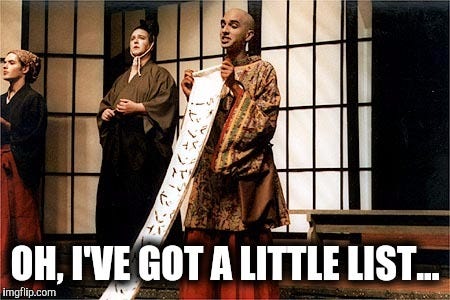
Your wish is my command. In the words of Gilbert and Sullivan:
Babel Studies BH101: Introduction to History (or lack thereof)
Item the First: you know nobody’s making you write a period piece, right?
In Babel, RF Kuang wants to discuss colonialism. She makes that bluntly and repeatedly obvious. And so the 1830s, at something like the peak of the British Empire’s power, would seem a rich lode to mine (little metal-based humour for you there).
But RF Kuang seems to be perversely adamant in her refusal to integrate her period setting in any meaningful way. And unfortunately, we’re going to have to nest our lists. We got lists within lists, babey.
Babel Studies BH101: Module 1: Language
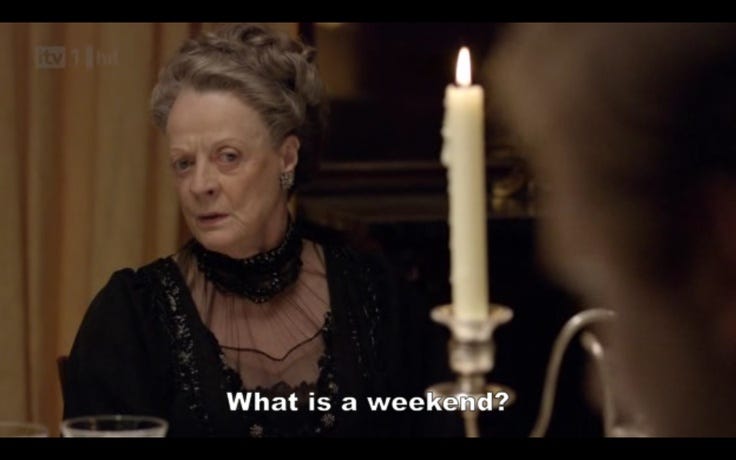
The characters in this book do not sound recognisably Victorian in any way. I flinched at the first ‘OK,’ but whatever, the word was popularised in 1840 in the States and maybe a bunch of young linguists might have come across it in the 1830s. Then one of the characters used the word ‘weekend,’ and not to sound all Cousin Violet off Downton Abbey, but:
Then someone said of someone who had difficulties in the Translator programme that they, and I quote, ‘couldn’t hack it,’ and I said, out loud, ‘come on now.’
But I knew I was truly beaten when a 19th-century man, with his whole chest, absolutely unblinkingly called Britain a ‘narco-military state’. Direct quote here.
This is because, as you might have spotted already: the characters of Babel do not just not sound like late Georgians slash early Victorians, they do sound recognisably like people who spend 18 hours a day on 2020s Twitter.
This language, incidentally, extends to how they talk about race, a pretty key theme in this book. I’m glad that I wasn’t subjected to repeated uses of the n-word, but it was an act of immense intellectual cowardice to not even try to find a way to get across some of the ways in which language is used to dehumanise POC. In a book notionally about language, starring people of colour in 1830s Britain, no less.
And the protagonist and his friends not only sound like veterans of 2020s Twitter, they think that way too.
Babel Studies BH101: Module 2: Attitudes
Babel is about colonialism. It is also about racism, or at least it thinks it is. And there is a lot of racism in Babel. Robin’s guardian Professor Lovell is nakedly racist. He is contemptuous about the Chinese - their work ethic, and their inherent worth as human beings. His illegitimate offspring are only of value insofar as their brains contain potential lodes of ‘match-pairs’ for him to mine.
The bigotry of Professor Lovell is explicitly on show in Babel, repeatedly and unsubtly. For example, early in the book Robin slightly slacks on his gruelling studies, and his guardian beats him brutally. He winds up the treatment with a monologue about the vices of Chinese people, as follows:
He sighed. ‘I hoped, based on Miss Slate’s reports, that you had grown to be a diligent and hardworking boy. I see now that I was wrong. Laziness and deceit are common traits among your kind. This is why China remains an indolent and backwards country while her neighbours hurtle towards progress. You are, by nature, foolish, weak-minded, and disinclined to hard work. You must resist these traits, Robin. You must learn to overcome the pollution of your blood.’
And, whatever, okay. It’s not like 1830s Britain was bigoted in a subtle way. I suspect there are more graceful ways to depict unsubtle racism, but I’m not going to wag my finger at RF Kuang for saying plainly ‘Hey these super racist rich white dudes are super racist.’ Sure. Fine. Whatever.
But what about the attitudes of its protagonists?
How do you think young Indian men in the 1830s felt about the Chinese? Or white women? Or Black women? How does a young Chinese man in the 1830s feel about these things?
The author makes absolutely no attempt to capture the ways in which the British Empire pitted people of colour against each other (in the way white supremacy still does), or the ways in which long exposure to white supremacy and/or misogyny might ingrain bigotry even within the marginalised. Not one of the POC in this book seriously grappled with internalised racism. In fact, Robin’s own feelings about his Chinese culture are a complete mystery to me. More on that later.
It’s not just about race, you understand. Professor Lovell and pals aren’t woke when it comes to Thee Wimmin, either.
‘Now, what I wish,’ interrupted Mr Ratcliffe, ‘is that all these women would stop taking part in those anti-slavery debates. They see too much of themselves in their situation; it puts ideas in their head.’
‘What,’ asked Professor Lovell, ‘is Mrs Ratcliffe unsatisfied with her domestic situation?’
‘She’d like to think it’s a hop and a skip from abolition towards suffrage.’ Mr Ratcliffe let out a nasty laugh. ‘That would be the day.’
Which…Great. Old rich white guys hate women. Love it. Fantastic. But again…how about the super special pals?
Neither of the women in the protagonist’s circle of friends seriously grapple with internalised misogyny. For the matter of that, the protagonist and his male bestie are terribly chill about their gal pals, to the extent that a late-in-the-game bit of misogynistic spite from the protagonist feels both gratuitous and out of left field.
And whatever, I’m not holding a candle for Old Rich White Guys. Old Rich White Guys have conceivably worse attitudes about race and gender than younger, less white, less dudely people. But surely you can find a way to portray a sliding scale between the shittiness of old rich reactionary white guys and young idealistic students, without making said young idealistic students sound like they’d stepped straight out of the twenty-first century?
It genuinely feels like RF Kuang is so mortally terrified of creating any sort of Problematic Representation for a character of colour that her characters of colour are near-uniformly Noble and Woke. Especially poor Victoire, the Haitian girl, who is so innocent of flaw or depth that the resulting portrait is kind of stunningly racist.
And more to the point, this terror of engaging with internalised bigotry is a tremendous missed opportunity. One that for a brief shining moment, it looked like RF Kuang might be seizing. Ramy, the Indian man, is playing up Indian Prince cosplay to a fascinated and credulous white audience. Robin asks why he has to exaggerate his own exoticism, and Ramy points out that he, unlike biracial and light-skinned Robin, cannot pass for white.
‘Why did you talk like that?’ Robin asked him once they were out of earshot. ‘And what do you mean, you’re actually royalty?’
‘Whenever the English see me, they try to determine what kind of story they know me from,’ Ramy said. ‘Either I’m a dirty thieving lascar, or I’m a servant in some nabob’s house. And I realized in Yorkshire that it’s easier if they think I’m a Mughal prince.’
‘’I’ve always just tried to blend in,’ said Robin.
‘But that’s impossible for me,’ said Ramy. ‘I have to play a part. Back in Calcutta, we all tell the story of Sake Dean Mahomed, the first Muslim from Bengal to become a rich man in England. He has a white Irish wife. He owns some property in London. And you know how he did it? He opened a restaurant, which failed; and then he tried to be hired as a butler or valet, which also failed. And then he had the brilliant idea of opening a shampoo house in Brighton.’ Ramy chuckled. ‘Come and get your healing vapours! Be massaged with Indian oils! It cures asthma and rheumatism; it heals paralysis. Of course we don’t believe that at home. But all Dean Mahomed had to do was give himself some medical credentials, convince the world of this magical Oriental cure, and then had them eating out of the palm of his hand. So what does that tell you, Birdie? If they’re going to tell stories about you, use it to your advantage. The English are never going to think I’m posh, but if I fit into their fantasy, then they’ll at least think I’m royalty.’
It’s a genuinely well-observed moment, pointing to the privilege of light-skinned, white-passing Robin. Basically all the book’s decent moments come from Ramy, by the way.
Of course RF Kuang cannot let her readers draw their own conclusions from this dialogue - the most subtle observation in the whole book, and you’ll notice it wasn’t especially subtle. No, Kuang immediately spells out the key messages in the passage in words of one syllable for her audience, whom she clearly suspects of reading with a concussion and/or three sheets to the wind.
This marked the difference between them. Ever since his arrival in London, Robin had tried to keep his head down and assimilate, to play down his otherness. He thought the more unremarkable he seemed, the less attention he would draw. But Ramy, who had no choice but to stand out, had decided he might as well dazzle. He was bold to the extreme. Robin found him incredible and a little terrifying.
Babel is over five hundred pages long, by the way. Perhaps you’re beginning to see why.
I mention this sequence because it is the first and last time that the book even flirts with exploring how different people of colour might experience colonialism differently.
For a book that’s supposedly about colonialism and white supremacy, starring people of colour, it’s such a shame to elide the ways in which race, sexuality and gender might intersect, the ways in which a Black woman’s experience of Empire might differ from a biracial and light-skinned Chinese man’s, which might differ from a Muslim man’s, or the ways in which white supremacy’s chains extend, insidiously, to the brains and souls of the victims of Empire. Especially since, in so many cases, the language they must learn is mediated to them by their oppressors. I will return to this later.
We’ve talked about some micro dimensions: the language characters use, and their attitudes. Now let’s get a bit more macro.
Babel Studies BH101: Module 3: Society
I mentioned that Babel is considerably researched. I guarantee you that RF Kuang has never once, in her genuinely impressive academic career, been accused of failing to show her work. She shows her work in this novel, one eye-crossingly indigestible wall of text at a time. Seamlessly-integrated. Positively balletic. Here’s a representative example of this literary Baryshnikov in action:
The vicissitudes of the world outside had now become impossible to ignore. This was about more than mill workers. Reform, unrest and inequality were the keywords of the decade. The full impact of a so-called silver industrial revolution, a term coined by Peter Gaskell just six years before, was just beginning to be felt across the country. Silver-powered machines of the kind William Blake dubbed ‘dark Satanic Mills’ were rapidly replacing artisanal labour, but rather than bringing prosperity to all, they had instead created an economic recession, had caused a widening gap between the rich and poor that would soon become the stuff of novels by Disraeli and Dickens. Rural agriculture was in decline; men, women and children moved en masse to urban centres to work in factories, where they laboured unimaginably long hours and lost limbs and lives in frightful accidents. The New Poor Law of 1834, which had been designed to reduce the costs of poverty relief more than anything else, was fundamentally cruel and punitive in design; it withheld financial aid unless applicants moved into a workhouse, and those workhouses were designed to be so miserable no one would want to live in them.
Nice summary, Rebecca. Very responsible of you to recycle that essay on 19th century British inequality you wrote for eighth grade history. We’re all about the circular economy nowadays.
Just one question, though: all this legislation, this worker unrest, seems er… magnificently uninflected by the fact that magic exists in the UK, no? The book pays lip service to the idea that technology is putting workers out of a job, which… totally non-magical technology as we know it, in present day, already was. The Peter Gaskell essay RF Kuang mentions was published when she said it was, and talked about the industrial revolution already. Is this industrial revolution hastened in any way by magic silver? Does the pace, scale, frequency of the unrest change?
At an earlier point in the novel, Professor Lovell and his dick Old Rich White Guy friends have the following superbly natural debate about the pros and cons of slavery after the 1833 abolition of slavery - which, yes, before you ask, happened exactly the same way in history, completely uninflected by magic silver:
In 1833, a momentous thing happened - slavery was abolished in England and its colonies, to be replaced by a six-year apprenticeship term as a transition to freedom. Among Professor Lovell’s interlocutors, this news was taken with the mild disappointment of a lost cricket match.
‘Well, that’s ruined the West Indies for us,’ Mr Hallows complained. ‘The abolitionists with their damned moralizing. I still believe this obsession with abolition is a product of the British needing to at least feel culturally superior now that they’ve lost America. And on what grounds? It isn’t as if those poor fellows aren’t equally enslaved back in Africa under those tyrants they call kings.’
‘I wouldn’t give up on the West Indies yet,’ Professor Lovell said. ‘They’re still allowing a legal kind of forced labour - ’
‘But without ownership, it takes the teeth out of it all.’
‘Perhaps that’s for the best, though - freedmen do work better than slaves after all, and slavery is in fact more expensive than a free labour market - ’
‘You’ve been reading too much of Smith.’
Why does Mr Hallows think abolition has ruined the West Indies for them? How might silverworking depend, or not, on enslaved peoples? How might the language of enslaved peoples and their gaps in translation be the next frontier of silverworking? Mining - and other extractive industries - are notoriously reliant on slavery and in general terrible labour conditions for even free people. Might those deserve a bit more integrated consideration in this book, rather than a didactic and hastily-tossed-off footnote?
For that matter, might the Oxford silverworkers not want lobbyists of some sort in Parliament to protect their interests? Might they not want to run for Parliament themselves? What laws might they want to push forward to protect their industry’s interests that would not have passed otherwise?
In short, can RF Kuang point to any way in which her magic system makes a thing happen that wouldn’t otherwise have happened at the same time in basically the same way? Are we going to think about how magic silver changes anything about the industrial revolution? Oh, we’re just tacking ‘silver’ before ‘industrial revolution’ and calling it a day? Outstanding, Rebecca, incredible feats of world-building there. How very Sarah J Maas of you.
Which is actually unfair to SJM, as I’ll touch on later.
But speaking of literature…
Babel Studies BH101: Module 4: Literature
In that big old wall of text about the ‘silver industrial revolution,’ do you remember the narration mentioning Blake and his ‘dark Satanic Mills’? You remember the nod to Dickens’s novels about inequality? Were you maybe expecting - or hoping for - some more detail on how Blake might riff on how the very words we speak are used to snatch away our livelihoods? Or how about Dickens? Might A Christmas Carol, for example, look and sound a little different? Maybe Ebenezer Scrooge is a tyrannical translator? Maybe the Ghosts of Christmas Past, Present and Future change his heart through the use of magic silver? Homegirl dutifully namechecks Mary Shelley too, and I dunno lads, I feel like the author of The Modern Prometheus might have had some things to say about magical silver powered by language that strands the working classes.
And admittedly, I am grateful to have been spared an RF Kuang pastiche of Dickens, or Shelley, or - Heaven Forfend - Blake. But could you not have made up a book title or a plot synopsis?
And speaking of Heaven…
Babel Studies BH101: Module 5: Religious Studies
Religion – Christianity in specific – seems to continue very much business as usual in this book. And yes, okay, the British by this point were a largely Godless people, but they seem to be ah. Kind of blase about magic silver, even for them. No cults or sects operating in response to magic? For that matter, why do the silverworkers allow missionaries to ply their trade uninterrupted? I’ll try to avoid spoilers, but a big part of the magic system of this book relies on not diffusing a language too widely. Wouldn’t missionaries get in the way of that?
And to illustrate just how obvious a world-building element this is: early in Sarah J Maas’s A Court of Thorns and Roses (ACOTAR for short), there’s a mention of weird fae-worshipping cults. Nothing comes of it, because Sarah J Maas does not actually plot her books, she just lets the spirit move her and stops when she’s run out of euphemisms for dick. But I would still like to point out that internationally bestselling fairyfucking epic ACOTAR at least considered that magic might influence religion, and award-winning Babel did not. Once again: ACOTAR.
And look, it’s one fantasy book. I’m not demanding that RF Kuang think of all of the ramifications of her alternate-history 1830s. But I do think that she should have thought of some.
That’s what Susanna Clarke does in her alternate-Regency Jonathan Strange & Mr Norrell, a comparison that RF Kuang herself invites with her use of footnotes.
And you know what, I can’t take it any more. Let’s talk about those footnotes.
Babel Studies BH101: Module 6: Marginalia
RF Kuang peppers Babel with footnotes. This provides the novel with the visual heuristic of a scholarly account, in keeping with that colon-heavy full title. You’ll recall that more than one of the novel’s laudatory reviews calls out those footnotes. The Guardian, in specific, compares the use of footnotes in Babel to the novels of Terry Pratchett and Susanna Clarke.
I will do the same.
You see, when Terry Pratchett or Susanna Clarke use footnotes, their voice, purpose and place in the overall narrative is very clear. Clarke is typically providing an overflow of detail in her richly-imagined history of magic in Britain. Pratchett is taking you on a gleeful tangent with a joke, or a stream of horrendous puns, that would break up the flow of the main text. The voice of the footnotes is also very clear: within the narrative, but tucked out of the flow of the main body.
Now I, a fool, might imagine that RF Kuang would follow the obvious path of Susanna Clarke. The footnotes might provide detail that would break the flow of the main narrative, but which lend richness and depth to her imagined alternate 1830s Britain. She might, for example, provide details of an imagined silverworkers’ uprising, brutally quelled by the use of magic. She might imagine surprising Christian anti-magic sects. She might address any of the points I’ve already mentioned. Or, since RF Kuang’s not actually big on imagining things, she could throw in additional historical research she’s conducted that doesn’t actually belong in the narrative, but which she thinks is cool.
Or she might go the Pratchett route and provide whimsical asides about little adventures that Robin and his super special pals go on, or random shit at his University - fun stuff that makes the world of her novel feel lived-in, but that doesn’t really belong in the main story.
Or, you know, RF Kuang could use the footnotes to make sure you, the reader, know that RF Kuang knows that colonialism is bad. That’s also an option.
Well, whichever option she chooses, argue I, a fool, she’s got to pick one. She can’t flit from quasi-Susanna-Clarke to quasi-Pratchett to Fourth-Wall-Breaking Scold willy-nilly. That would be confusing. That would be distracting. That would be a fucking mess.
It would, wouldn’t it?
Occasionally Babel’s footnotes serve a clearly-understandable purpose in the same approximate ‘voice’ of the main body of the novel. They provide genuinely very interesting information on the etymology behind match-pairs, or provide an aside fleshing out the imagined 1830s of the novel. For example, on a much-vaunted match-pair used in espionage applications:
The military applications of this match-pair were really not as useful as Professor Playfair made them sound. It was impossible to specify which pieces of knowledge one wanted to remove, and often the match-pair only caused enemy soldiers to forget how to lace their boots, or how to speak the fragmented English they knew. The Duke of Wellington was not impressed.
Most of the world-building asides actually would be more interesting in the main body. For example, here’s a footnote on silver bar duplicates:
As with all valuable and expensive things, there was a massive underground market for counterfeit and amateur silver bars. At New Cut, one could buy charms to Banish Rodents, to Cure Common Ailments, and to Attract Wealthy Young Gentlemen. Most were composed without a basic understanding of the principles of silver-working, and involved elaborate spells in made-up languages often in imitation of Oriental languages. Yet some were, occasionally, rather incisive applications of folk etymology. For this reason, Professor Playfair conducted an annual survey of contraband silver match-pairs, though the use of this survey was a matter of utmost secrecy.
In fact, RF Kuang banishes a lot of significant character detail to a wall of expository text in footnotes. For example, here is a whole psych profile of Robin’s half-brother Griffin, who inducts Robin into a revolutionary secret society and dies a martyr to the cause:
He would never know, for instance, that there was a time when Griffin, Sterling, Anthony, and Evie had thought of themselves as a cohort as eternally bonded as Robin’s did; or that Griffin and Sterling had quarrelled once over Evie, bright and vibrant and brilliant and beautiful Evie, or that Griffin truly hadn’t meant it when he’d killed her. In his retellings of that night, Griffin made himself out to be a calm and deliberate murderer. But the truth was that, like Robin, he’d acted without thinking, from anger, from fear, but not from malice; he did not even really believe it would work, for silver responded only sporadically to his command, and he didn’t know what he’d done until Evie was bleeding out on the floor. Nor would he ever know that Griffin, unlike Robin, had no cohort to lean on after his act, no one to help him absorb the shock of this violence. And so he’d swallowed it, curled in around it, made it a part of himself – and while for others this might have been the first step on the road to madness, Griffin Lovell had instead whittled this capacity to kill into a sharp and necessary weapon.
Well, all right then. Good to know. Might have been even nicer to have in the main text if you think we need to know it, perhaps, Rebecca?
Well, you say, Griffin’s not the protagonist or his super special pal. I suppose he doesn’t need to be fleshed out in the main body of the text. Robin gets his character development in the main text, right?
Oh, we’ll get there. We’ll get there next letter.
But in the meantime, let’s talk about the primary use of footnotes in Babel.
Suppose you’re an author: well-intentioned, left-leaning, well up on your Marxist theory, terminally online. You’re writing a novel set in the past, and run into a problem well-known to historians: the past, as they say, is a different country. People in the 1830s didn’t think like we do about slaves, about women, about non-white people. Any portrait of such people depicts behaviours and attitudes that the veriest clod would recognise as Problematic. And depiction is the same thing as endorsement - or can be to a certain class of well-intentioned, left-leaning, well up on Marxist theory, terminally online leftist. What’s a gal to do?
One option is to trust that your readers are adults who can recognise white supremacist systems as bad. This is aided by illustrating the ways in which your protagonists battle racism and/or misogyny. This, of course, is a risky, near suicidal course of action, and you reject it out of hand. Quite sensibly, might I add.
A second option is have your protagonists display distinctly modern attitudes to race and gender, in sharp contradistinction to the evil rich white guys. This approach clearly illustrates the difference between the Good, Non-Problematic Characters, and the Bad, Problematic Characters. Now, this is better, but still not failsafe.
But what if you went a step further? Every time you mention an event, tap your audience on the shoulder and spell out the ethical or political failings of the institution, or academe. Make sure your audience can’t move for footnotes reminding them that Racism is Bad, mmkay? This way, even the shittiest, worst-faith Reply Guy in your mentions can’t accuse you of glorifying the indefensible.
‘All right,’ you say, ‘I think you’re coming on a bit strong here.’
Oh, am I?
For example, at one point the super special pals are talking about slavery in the Empire. Letty, the white Englishwoman, is earnest about how relatively virtuous Britain is. ‘But, Victoire love,’ she says, ‘the slave trade was abolished in 1807.’
Barely are the words out of her mouth when the footnote bustles in with:
This is a great lie, and one that white Britons are happy to believe. Victoire’s following argument notwithstanding, slavery continued in India under the East India Company for a long time after. Indeed, slavery in India was specifically exempt from the Slave Emancipation Act of 1833. Despite early abolitionists’ belief that India under the EIC was a country of free labour, the EIC was complicit in, directly profited from, and in many cases encouraged a range of types of bondage, including forced plantation labour, domestic labour, and indentured servitude. The refusal to call such practices slavery simply because they did not match precisely the transatlantic plantation model of slavery was a profound act of semantic blindness. But the British, after all, were astoundingly good at holding contradictions in their head. Sir William Jones, a virulent abolitionist, at the same time admitted of his own household, ‘I have slaves that I rescued from death and misery, but consider them as servants.’
You got that, right? The racist British imperialists were hypocrites and famous historical supervillain East India Company was bad.
Want another one? Early in the book, Robin picks up a boys’ adventure story by Frederick Marryat, the reading of which causes him to miss a tutorial and get savagely punished by Professor Lovell. While the main body of the text dwells on Lovell’s brutality and the racist tirade that follows it, the footnote tells us:
This was to be the last Marryat title Robin ever read. It was just as well. Frederick Marryat’s novels, though full of the high seas adventuring and valour that endeared them to young English boys, also portrayed Black people as happy, satisfied slaves and American Indians as either noble savages or dissolute drunks. Chinese and Indians he described as ‘races of inferior stature and effeminate in person’.
Got all that? It was Bad that Robin got beaten for a harmless error, but at least he never touched the Bad Wrong Problematic Author Again.
19th Century Imperialists Bad. But RF Kuang Good. RF Kuang Purer Than Driven Snow. Or Other Simile Without Problematic Implication That Snow Pure, Since Snow White Therefore Insinuating That Snow Proverbially Pure Entrench Centuries-Old White Supremacist Conflation Of Whiteness With Purity And Therefore Virtue, Which Conflation Bad. RF Kuang Not Bad. RF Kuang Good. Reviewer Bad For Eschewing Articles And Connective Verbs. Reviewer Parodying ‘Me Tarzan, You Jane’ Made Infamous In Adaptations of Tarzan by Edgar Rice Burroughs. Edgar Rice Burroughs Proud Eugenicist And Scientific Racist. Edgar Rice Burroughs Propagate Eugenicist and Scientific Racist Ideas in Tarzan. Eugenicism and Scientific Racism Bad. Reviewer Parody Tarzan Patterns, Which Racist. Reviewer, Ergo, Racist. Racism Bad. Reviewer Bad. But RF Kuang Good.
And look, even the finger-wagging footnotes might work, if deployed intentionally. Babel is supposed to be a history of the Oxford Translators’ Revolt, right? So frame the novel as a history, written by a twenty-first century wokescold. Get rid of the alleged third-person limited perspective and employ quote-unquote primary sources and contemporary accounts. Lean in to the hectoring and the priggishness of the footnotes. Make them a feature, rather than the bewildering and distracting bug they currently are.
But nope. Nope, instead I’m sitting here wondering who the hell is this time-travelling twenty-first-century pedant who is also intimately privy to the perspective of an early-nineteenth-century teenager.
But hey. At least you know RF Kuang doesn’t condone colonialism, right? Because RF Kuang really can’t take the chance that you separate this work of fiction written by RF Kuang from the life of RF Kuang and beliefs of RF Kuang.
Thank you for attending Babel Studies’ early courses! Next term in Babel Studies:
Babel Studies 201: On The Necessity of Writing A Work of Fiction When You Say You’re Writing A Work of Fiction
Babel 202: Further Reading
Please Leave the Class in an Orderly Manner
Or fire up Rock n’Roll High School. The Ramones, like RF Kuang, don’t care about history.
On the world building, what drove me up the wall in the book was her refusal to engage with the amount of silver in possession of the Spanish Empire. Again, it Spanish imperial decline might have gone differently in a world with SILVER MAGIC of which their colonies had A METRIC SHITTON. It did not let me go the entire book. What happened to the Spanish Empire?????
Excellent review. I liked the book well enough, although it’s rather pulpy. For all of Kuang’s linguistic prowess, she does make some elementary mistakes in the use of Chinese and there’s also a cringe-worthy error in her Devanagari (that is, in the spelling of a Sanskrit verb root). If you’re going to flourish “linguistic exotica”, it’s best to double check them.